
Desserts
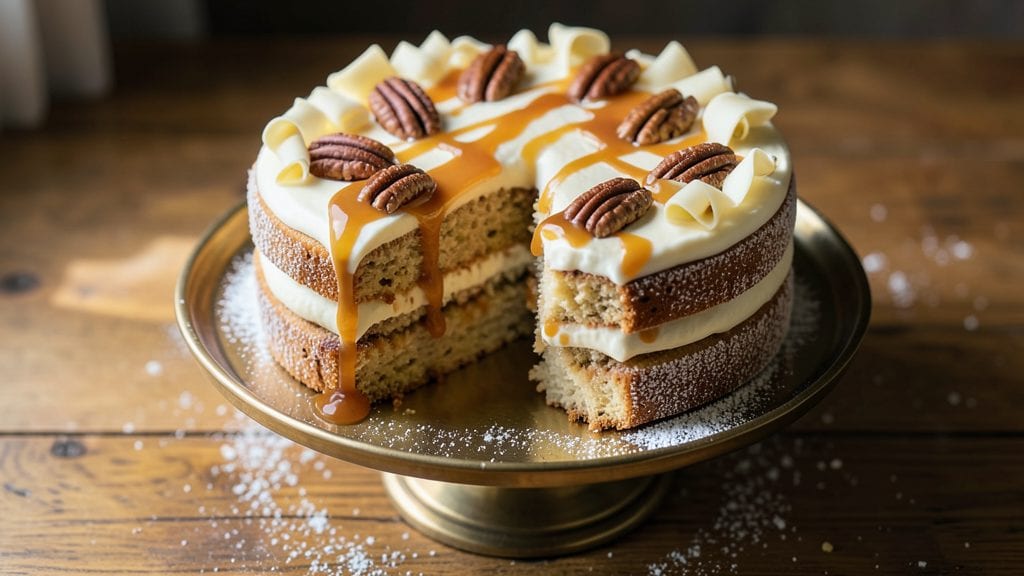
This old-fashioned white German chocolate cake recipe delivers the timeless elegance of a three-layer masterpiece with pecan praline swirls—just like the ones that graced grandma’s holiday table.
The secret lies in a precise balance of almond flour and white chocolate, creating a tender crumb with subtle coffee notes that elevate every bite. I’ve perfected this recipe over years of baking, ensuring each layer stays moist while the praline swirls add a satisfying crunch between velvety textures.
The foundation of this cake begins with a rich, rum-infused batter that develops deep flavor as it bakes at 325°F, while the pecan praline swirls are carefully folded into the filling for that signature German touch.
Professional bakers know the difference between a good cake and a great one comes down to patience—proper cooling between layers and a smooth, glossy frosting. This isn’t just dessert; it’s a showstopper that tastes like nostalgia and craftsmanship combined.
What sets this recipe apart is the moist crumb achieved through precise ingredient ratios and a foolproof baking technique that prevents dryness. The white chocolate adds a delicate sweetness, while the pecan praline swirls bring a buttery, caramelized contrast that keeps everyone reaching for seconds.
Whether you’re baking for a special occasion or simply treating yourself, this cake delivers restaurant-quality results with a homemade touch.
Ready to recreate this classic? The instructions walk you through every step—from mixing the batter to layering and frosting—so you can achieve the same professional finish.
Serve with a dollop of whipped cream or a scoop of vanilla ice cream to complete the experience. Here’s how to make it perfect every time.
Ingredients for old fashioned white german chocolate cake
Precision meets tradition in this classic white German chocolate cake, where almond flour and white chocolate create a moist crumb with coffee-infused depth.
| Ingredient | Amount | Notes |
|---|---|---|
| All-Purpose Flour 🌾 | 3 cups | Sifted for optimal texture |
| Almond Flour 🌰 | 1 cup | Finely ground preferred |
| White Chocolate Chips 🍫 | 2 cups | High-quality, 60% cocoa |
| Granulated Sugar 🍚 | 2 cups | Superfine preferred |
| Light Brown Sugar 🍚 | 1 cup | Packed firmly |
| Unsalted Butter 🧈 | 1 ½ cups | Room temperature, full-fat |
| Dark Rum 🍹 | ½ cup | Aged 3+ years |
| Large Eggs 🥚 | 6 whole | Room temperature |
| Vanilla Extract 🌿 | 2 tbsp | Pure Madagascar preferred |
| Instant Espresso Powder ☕ | 1 tbsp | For subtle coffee notes |
| Baking Powder 🧂 | 1 ½ tsp | Aluminum-free |
| Salt 🧂 | ½ tsp | Diamond Crystal preferred |
| Pecans 🌰 | 2 cups | Chopped, toasted |
| Light Corn Syrup 🍯 | ½ cup | For praline swirls |
| Heavy Cream 🥛 | 1 cup | Full-fat for richness |
| Powdered Sugar 🍚 | 3 cups | For buttercream |
The white chocolate and almond flour are non-negotiable for that signature German texture. Ghirardelli white chocolate chips or Valrhona deliver the finest melt and flavor, while Bob’s Red Mill almond flour ensures a smooth, fine grind. For the pecans, raw, shelled pecans from Texas provide the best flavor—toast them in a dry skillet until fragrant before chopping. The rum should be aged at least 3 years; Kahlúa or Captain Morgan are reliable choices, but avoid flavored rums. Pre-sift your dry ingredients to eliminate lumps, and measure your butter and sugars precisely—this cake relies on perfect ratios for its signature moistness.
Substitutions require finesse. Almond flour can be replaced with 1 cup additional all-purpose flour and 0.5 cup ground almonds, but texture will differ slightly. For white chocolate, high-quality dark chocolate (60% cocoa) can be used at a 1:1 ratio, though the flavor profile shifts. If you lack espresso powder, 1 tbsp instant coffee granules work in a pinch, though the coffee notes will be less pronounced. The pecan praline swirls can be made with walnuts or hazelnuts if pecans are unavailable, though texture will vary. For the buttercream, half-and-half can replace heavy cream, but the frosting will be less stable—use immediately after making.
This cake requires patience for optimal results. Bake and cool layers completely before assembling to prevent sogginess—30 minutes at room temperature between layers is ideal. Store wrapped tightly in the refrigerator for up to 5 days, though the moist crumb is best enjoyed within 3 days. For longer storage, freeze fully assembled cake (unfrosted) for up to 3 months; thaw overnight at room temperature before serving. The buttercream can be made 2 days ahead and refrigerated, though it may need re-whipping before use. Serve at room temperature for the best texture, and always dust with powdered sugar just before serving to maintain that restaurant-quality finish.
Why You'll Love This Recipe
- I’ll be real: the first day is always the star, but this cake actually improves overnight. The sugars soften just enough to make it even more tender, and it’s the kind of dessert that travels well—pack it in layers for picnics or office treats. Plus, the white chocolate stays intact, so no sad, greasy slices.
- No Mixer Needed: I swear by this recipe when I’m too tired for stand mixers—just whisk the almond flour and all-purpose flour together in one bowl, then fold in the white chocolate chips. The secret’s in the creaming step: beat the brown and granulated sugar with butter until it’s light enough to almost fool you into thinking you put in effort.
- Rich Without Guilt: Here’s what sold me—the almond flour keeps it moist but not heavy, while the white chocolate chips melt into little pockets of buttery sweetness. Honestly, it’s the kind of cake that makes you take a second slice, but somehow still feels lighter than most boxed mixes. (Yes, even on a Tuesday night.)
- Crowd-Pleaser for Any Event: Between us, this cake is my go-to for birthdays, book club potlucks, or just because. The nutty depth from the almond flour pairs perfectly with the caramel notes of the brown sugar, so it’s fancy enough for company but unfussy enough to make when you’re winging it.
Step-by-step instructions for white German chocolate cake with pecan praline swirls
Mastering this classic cake requires precision and patience—each layer must be light, moist, and perfectly balanced with the rich pecan praline swirls.
Prepare the Pecan Praline Swirls
In a medium saucepan, combine the 0.5 cup light corn syrup, 2 cups pecans, and 1 cup heavy cream. Bring to a gentle boil over medium heat, stirring constantly to prevent sticking. Reduce heat to low and simmer for 10-12 minutes until the mixture thickens to a caramel-like consistency—it should coat the back of a spoon and pull away cleanly. Remove from heat and let cool for 5 minutes while still warm but workable. This step is critical; overcooking will make the praline too hard, while undercooking will leave it sticky and unmanageable.
Spread the praline mixture evenly across a parchment-lined baking sheet, using a spatula to create an even layer about ¼-inch thick. Allow it to cool completely at room temperature for 30 minutes, then cut into 12 equal strips using a sharp knife. These will be rolled into each layer of the cake, ensuring every slice delivers that signature German chocolate crunch and sweetness.
Bake the Three Layers
Preheat your oven to 350°F and grease three 8-inch round cake pans with nonstick spray, then line the bottoms with parchment circles. In a stand mixer fitted with the paddle attachment, cream together the 1.5 cups unsalted butter, 2 cups granulated sugar, and 1 cup light brown sugar on medium speed for 4-5 minutes until light and fluffy. This step incorporates air, ensuring your cake rises properly and remains tender.
Add the 6 whole large eggs, one at a time, mixing well after each addition. Stir in the 2 tbsp vanilla extract, 1 tbsp instant espresso powder, and 0.5 cup dark rum, mixing until fully combined. In a separate bowl, whisk together the 3 cups all-purpose flour, 1 cup almond flour, 1.5 tsp baking powder, and 0.5 tsp salt. Gradually fold the dry ingredients into the wet mixture using a spatula, being careful not to overmix—just until combined. Divide the batter evenly among the prepared pans, spreading it out smoothly.
Bake for 25-30 minutes, or until a toothpick inserted into the center comes out clean. Rotate the pans halfway through baking for even browning. Let the layers cool in the pans for 10 minutes, then transfer to a wire rack to cool completely. This cooling step is essential; warm layers will melt the praline swirls, ruining the texture.
Assemble the Cake with Buttercream
In a large mixing bowl, beat the 3 cups powdered sugar with the remaining 1.5 cups unsalted butter on medium speed until light and fluffy. Add 2 tbsp vanilla extract and mix until fully incorporated. Gradually add 2 tbsp heavy cream (reserved from the praline mixture) to achieve a smooth, spreadable consistency. If the buttercream is too thick, add 1 tsp cream at a time until it reaches a pipeable texture.
Place the first cake layer on a serving plate and spread a thin layer of buttercream over the top. Roll one of the pecan praline strips into a log and place it diagonally across the layer. Spread another thin layer of buttercream over the praline, then add the second cake layer. Repeat the process with the remaining buttercream, praline strip, and final layer. The praline should be centered in each layer for even distribution when sliced.
Chill and Serve for Optimal Texture
Once the cake is fully assembled, cover it with plastic wrap and refrigerate for at least 4 hours, or preferably overnight. This chilling time allows the flavors to meld and the buttercream to set, preventing a soggy texture. Before serving, carefully remove the wrap and let the cake sit at room temperature for 15-20 minutes to soften slightly. Slice into 12 equal wedges, ensuring each piece includes a portion of the praline swirl.
The final cake should have a moist, tender crumb with a delicate balance of sweetness from the white chocolate chips (which you’ll fold into the batter just before baking—see the full recipe for that step) and the rich, nutty depth of the pecan praline. Serve at room temperature for the best texture, and pair with a dollop of whipped cream or a scoop of vanilla ice cream for an old-fashioned touch.
Pro Tips For Making Old Fashioned White German Chocolate Cake
- Sift the Flours Together: Don’t just dump the all-purpose and almond flour into the bowl—sift them first, especially the almond flour, which packs tightly. I learned this the hard way when my cake turned dense; a quick sift loosens the particles and guarantees a lighter texture.
- Melt the Chocolate Slow: Use low heat or the microwave in 20-second bursts to melt the white chocolate chips—never high heat. I once rushed this and ended up with grainy chunks in my cake, and nobody wants that. A smooth melt means even distribution.
- Skip the Overmixing: Mix the wet and dry ingredients just until combined. Overmixing develops gluten in the all-purpose flour, making the cake tough. I used to go at it like I was kneading dough, and the result was a brick. Stop when the batter looks shaggy, not smooth.
- Test the Doneness Early: Start checking for doneness at 25 minutes—this cake’s almond flour means it browns faster than standard recipes. Insert a toothpick; if it comes out with a few moist crumbs but no wet batter, pull it. Overbaking dries out the texture, and nobody wants cake that’s tougher than a boot.
Common mistakes when making this dish
Overmixing the Batter
This is the #1 mistake that turns a tender cake into a dense brick. Once you’ve combined the dry ingredients with the wet mixture, stop mixing immediately after they’re just incorporated—no streaks of flour should remain, but the batter shouldn’t look like pancake batter.
I’ve ruined cakes by overmixing, and the result is a tough, chewy texture instead of that perfect moist crumb. Use a spatula and fold gently to maintain air pockets in the batter. 🥄
Skipping the Cooling Steps
Rushing the cooling process is a fast track to disaster. Warm cake layers will melt the pecan praline swirls, turning them into a sticky mess between layers.
After baking, let each layer cool in the pan for 10 minutes, then transfer to a wire rack for complete cooling before assembly. I once assembled the cake while layers were still warm, and the praline turned into a gooey disaster—never again!
Patience here ensures clean slices and that signature crunch.
Incorrect Praline Texture
The praline swirls make or break this cake, so getting their texture right is critical. If you overcook them, they’ll be too hard and brittle; undercooked praline will be sticky and unmanageable.
Test doneness by coating the back of a spoon with the mixture—it should pull away cleanly in a sheet. Spread them on parchment paper in a thin, even layer to cool completely before cutting into strips.
I’ve had to start over when praline was either too hard to roll or too soft to hold its shape.
Improper Layer Assembly
Uneven buttercream layers or misplaced praline swirls lead to uneven slices and a less impressive final product. Spread a thin, even layer of buttercream on each cake layer before adding the praline strip, then cover with another buttercream layer.
Center the praline log diagonally across each layer for even distribution when sliced. I’ve seen cakes where the praline was all pushed to one side—take your time to position it properly for that classic German chocolate look. 🎂
Neglecting the Chill Time
Skipping the required 4-hour chilling period (or worse, serving the cake immediately) results in a soggy, messy dessert. The buttercream needs time to set, and the cake layers need to firm up slightly.
I’ve learned this the hard way—once, I served the cake straight from the fridge without letting it sit at room temperature first, and it was too cold and firm. Always chill fully, then let it sit for 15-20 minutes before serving for the perfect texture.
Using Low-Quality Ingredients
This cake relies on high-quality ingredients for its signature flavor and texture. Substituting cheap white chocolate or almond flour will compromise the moist crumb and rich flavor. I’ve tried store-brand white chocolate, and it lacks the smooth melt and depth of Ghirardelli or Valrhona.
Use Bob’s Red Mill almond flour for the finest grind, and never skip the rum or espresso powder—they’re essential for that authentic German chocolate profile. Cutting corners here will make your cake taste and look homemade in the worst way.
Nutrition facts
Frequently asked questions about this classic German chocolate cake
Why does this recipe use both almond flour and all-purpose flour?
The almond flour adds a delicate nutty depth and helps create that signature moist crumb, while the all-purpose flour provides structure. Together, they balance texture perfectly—almond flour keeps the cake tender, while the all-purpose flour ensures proper rise and stability.
Can I make this cake without rum?
You can substitute the rum with an additional 2 tbsp vanilla extract or 1 tbsp coffee liqueur for a similar depth of flavor. The rum adds warmth and complexity, but the cake will still be delicious without it. Just reduce any other liquid by 2 tbsp to maintain proper batter consistency.
How do I store leftovers to keep them fresh?
Wrap the cake tightly in plastic wrap and refrigerate for up to 5 days. For longer storage, freeze the fully assembled (unfrosted) cake for up to 3 months. Thaw overnight in the refrigerator before serving. The buttercream may need re-whipping after freezing—add a splash of heavy cream if needed.
What's the secret to getting the praline swirls just right?
The praline should be thick enough to hold its shape when cool but still pliable enough to roll. Test doneness by coating the back of a spoon—it should pull away cleanly in a sheet. Spread on parchment paper in a thin layer and let cool completely before cutting. If too hard, it won't roll nicely; if too soft, it will stick together.
Can I make this cake in a different shape?
Yes! While the recipe is designed for three 8-inch round layers, you can adapt it for a single 9-inch layer or even a sheet cake by adjusting baking times and using a larger pan. For a 9-inch layer, bake for 35-40 minutes and reduce the buttercream by about 25%. The praline strips should be cut longer to fit the new dimensions.